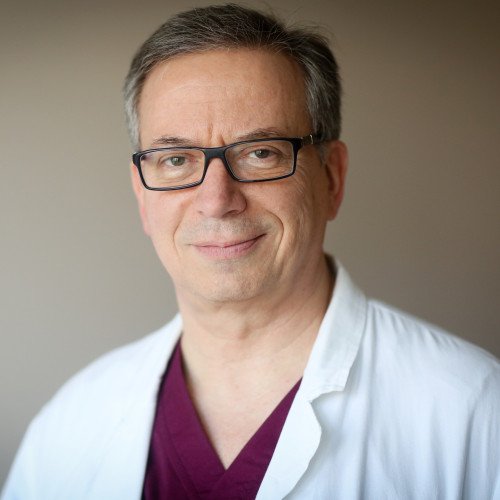
Dr. Péter Kovács
Szülész-nőgyógyász főorvos
 english-speaking doctor
Dr. Péter Kovács wants to gift women with lifelong happiness. For our hospital's obstetrician-gynecologist, understanding the mutual influence of the human psyche and bodily processes has provided a solid philosophical foundation for his medical work.
Dr Péter Kovács wants to gift women with lifelong happiness. For the obstetrician-gynecologist of our hospital, understanding the mutual influence of the human psyche and physical processes has provided a solid philosophical foundation for his medical work. As a sexologist, he strives to prevent relationship crises, which is the only way to preserve physical health. He believes in the mission, which his life is the best example of.
I come from an economist family, but my first serious plan for my future as a child was medicine, and even gynecology. I even wanted to be a driver before, but I soon realized that I could do that alongside any occupation. Although I prepared for medicine quite consciously, I attended a strong biology-chemistry-Latin class at Szilágyi Erzsébet High School, and I once wavered at the end of high school. While preparing for the entrance exam, I fell in love with physics so much that it occurred to me: I would rather apply to be a physicist. However, there was a very smart boy in my class who could almost shake the entire physics material out of his little finger, while it took me a lot of brainstorming to understand the connections perfectly. I thought that there would be only students like that in the physics department, and so I ended up sticking with my original idea, a medical career.
Did your oldest goal persist throughout university: obstetrics and gynecology?
Once there, I was unsure, attracted by the possibility of becoming an orthopedic surgeon, but then I saw a birth, and from then on I unwaveringly prepared to be an obstetrician and gynecologist. That was a miracle! I did my obstetrics internship in Veszprém, and for the first time I had the opportunity to lead a birth from the first minute all the way to the suture of the dam, of course with supervision. It was a great experience. For example, I had no idea until then how painful labor was. The tension before the baby came out was exciting, as everyone was waiting for the big moment. Then the immense happiness after the baby was born, the mother's relieved crying. I was so moved by what I experienced there that I cried myself. And from then on, I knew that this was all I wanted to do.
Was your first job filled with similarly defining experiences?
Yes! I believe that the first job has a special significance. Of course, I didn't have much choice when it came to finding a job, there were so few obstetrician-gynecologist positions at the time that I was happy with the only invitation. That's how I ended up in Tapolca, where I received a lot during the two years I spent there. I learned a lot and worked a lot. In the first period, I worked 15 shifts alongside a colleague, and then worked the next day. And from the following month, they “threw me into the deep end”: I was now taking care of ten by myself. They trained the young doctors to work hard and precisely, which was a good foundation.
Having gained the necessary confidence, did you boldly look for a new opportunity?
That’s right. I wanted to come back to Budapest. I got a versatile job in Újpest, and in addition to the hospital duties, I also treated patients in the fourth and fifteenth district specialist clinics. It was a hospital with significantly more traffic than the one in Tapolca; for example, the number of births was double that of the previous ones, and the number of patients in the hospital was also significant. I spent thirteen years there, then the merged institution was separated, and I stayed at the Rákospalotai Specialist Clinic. Later, the then professor of the Szabolcs Street Hospital asked me to be a colleague, and a wonderful period followed. I was given significant independence, I could schedule my appointments and surgery times. I enjoyed this enormous freedom immensely. Unfortunately, the 2007 hospital closure madness also reached the Szabolcs Street maternity ward. And there I was faced with the question of “what to do next?”, the dilemma of choosing a public or private institution.
In the end, I decided on a private hospital. Was it difficult to convince me of the unknown at the time?
No, although I thought about it. I knew that this step of mine would have disadvantages, but I hoped that I would soon find its advantages. It is a completely different type of work to work in a private institution. The requirements from the patients and the owners are completely different, so you have to meet a different quality of expectation in terms of style as well. Of course, this is close to me, so I chose the Róbert Hospital from the options offered at the time, and I was among the first to come here. What we do here perfectly suits my way of thinking and outlook on life. The women who choose us have a clear idea of what kind of birth they want. Our job is to provide them with this experience at the highest level possible, and we pay extraordinary attention to them. Although as a chief physician I try to expect a similar approach from my colleagues in the specialist clinic, the circumstances are completely different. With the “conveyor belt”, there is no possibility of everything we would like. Here there is enough time, the conditions are ideal, and the rest is up to me.
You also deal with a very important thing: sexology. How did you get involved with this field of science?
It has a really good story. While I was still a doctor at the Szabolcs Street obstetrics department, I participated in the so-called A-HA program, which provided sexual education to adolescents. I gave lectures in quite a few schools and talked to young people. Since I worked a lot at the obstetrics department, I had a lot of free time after the department closed. During this “good time”, I was asked to answer young people’s questions as a web doc on the A-HA website. They wanted to launch the website and were looking for a doctor who could find a good tone with adolescents. In a short time, the website became very popular, and I fell in love with this task. I admit: at first I was hesitant to write because I didn’t like typing, but then it went so easily and well, and I received such great feedback that I was happy to do it. There was a day when I spent 8 hours answering questions. Those three years enriched me with a huge experience.
You could have ended it here, because in the meantime you were getting more and more patients here at Róbert. But you invested even more energy in this area. Why?
I felt like a bit of a mission. I received a letter from the SOTE Further Education Center, inviting me to train as a sexologist and sex therapist. I felt that if fate was taking me in this direction, I had to do it. The course was one year long, and at the end it ended with a thesis. I thought about it a lot. Then I realized that I had always been interested in the stories of my patients, which allowed me to see behind the gynecological problem or in many cases pointed beyond the specific disease. I had already researched what could have led to a particular change.
Could these even be more serious diseases?
Of course. Since I was able to learn about the personal stories of most of my patients before and after childbirth, in addition to their illnesses, I realized how seriously people's emotional lives affect their health. I tried to identify with my patients' problems and, with the help of good questions, find the real causes. For example, a significant number of women develop bleeding disorders as a result of the enormous stress they are under. If a woman's self-esteem is violated, it manifests itself in countless lower abdominal problems. I discovered that their married life, that is, their relationship, greatly influences their health awareness in addition to their well-being.
Do the violations of their femininity manifest themselves in problems with their female organs?
Exactly. And as I dissected this, three questions arose in my mind: How long does love last? What is its purpose? And finally, what remains after it? Based on this, I created a questionnaire consisting of 27 questions and posted it online. To my greatest surprise, 227 love stories were received in two weeks, which I statistically evaluated. And based on this, I wrote my thesis analyzing the different stages of love. I divided love into six parts: 1. attraction, 2. passion, 3. balanced stage, 4. endangered stage, 5. breakup, 6. the period until the next love, this is an era in a person's life. It turned out that if the relationship does not even consider having a child, then this period lasts an average of 46 months, if the desire for a child is expressed, then 80 months, and if pregnancy is conceived, then the average duration of the relationship is 120 months. And I managed to establish another interesting thing: the expected dates of disappointment and the expected dates of birth of the child perfectly overlapped. So the purpose of the bonds, which is why nature released love on us, is obviously to prevent humanity from becoming extinct.
That's why instincts exist...
I created a website where I now help interested parties with hundreds of questions in managing their emotional lives in a balanced way and choosing a partner. For example, if someone is currently experiencing a balanced phase in their emotional life, we can use the answers to the questionnaire to calculate when a change can be expected, which they can prepare for or prevent.
Is this help before couples therapy?
That's right. Couples therapy is an often belated response to a crisis that has already developed. This is prevention. The website tries to draw attention to when a crisis can be expected, and what can be done before it develops. The goal is very simple: for people to feel good in their relationships! When couples are in love and happy, they believe that they will live their whole lives together. I want to help them with this. The long-term goal is to maintain physical health by maintaining mental health.
And how do you take care of your own health? What can you do to relax and unwind?
I feel very good with my family, it is always refreshing to be with my wife, children, and grandchildren. My daughter continues the family's economic branch, and my son is studying to be an obstetrician-gynecologist, which I am very happy about. We talk about the profession an incredible amount. My wife and I travel a lot, we love exploring unknown cities and places. I also pay attention to my fitness, I regularly go to karate, and I often ride a motorcycle with my boyfriend. Since my profession is also my hobby, I do a lot of it in my free time. I am currently nearing the end of a project, I invented a swimming pool patch for women. My patients complained that they could not enjoy swimming because they were constantly afraid of infections, so I thought I had the solution. I "experimented" with a patch that completely prevents water from entering. It's called the PekoBelt swimming pool patch, which gives women the peace of mind of a relaxing swim.

 Log in with GoodID