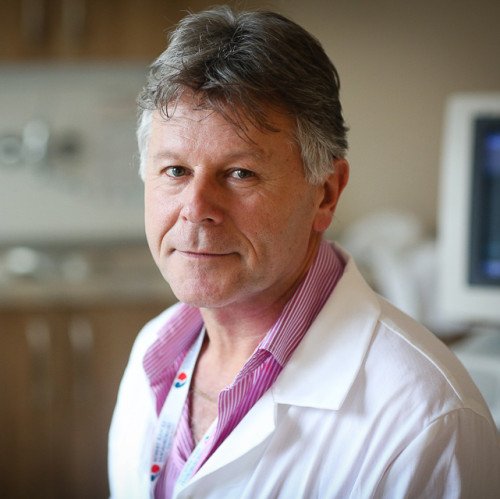
Dr. Ferenc Sándor
Vascular surgery
 english-speaking doctor
The surgeon of painless surgeries. He studied endovascular procedures at the Heidelberg University Clinic, and along with two other colleagues, he began the introduction of the method in Hungary. He performed the first radiofrequency varicose vein surgery at the Telki Private Hospital.
“It started when I was a child”
He was already preparing for a medical career as a child, because it was so noble for him that someone was a doctor and could heal people. People smiled at him, but this did not hinder him from achieving his goals at all. He says in retrospect: he made a very good decision, he found his calling. He considers it a success that he successfully handled all the obstacles in the Hungarian healthcare system, and received constant confirmation that he was on the right track.
He believes that in medicine – as in other fields – quality is more important than quantity. This conviction guided him when he opened his private practice relatively early, in 2008. Here he allocates his time himself and is able to provide the right amount and quality of time for his patients.
“The beginnings? After obtaining my doctoral degree, the surgical department of the Gyula Nyírő Hospital was my home base, where I took my specialist examination after several years of practical experience. Although it was a long time ago, I will never forget my first independent surgery, I operated on a 17-year-old girl with appendicitis. Every surgeon has a memorable first surgery.
I passed my specialist examination in surgery, then looked for new challenges, and since I was very interested in vascular surgery, I chose the Department of Vascular and Cardiac Surgery at SOTE. There I got the opportunity to get to know and master this field of expertise, so I took my specialist examination in that field as well.”
The surgeon’s “third eye”
He worked at the Szent János Hospital, where he also performed surgical and vascular surgery tasks. The diverse surgeries and high patient turnover increased the high level of practice he had previously acquired.
“As a department and duty manager, I also participated in emergency care, as well as in the professional training of medical students and residents about to take their exams.
I increasingly felt that surgery was my own. It is extraordinary to experience the spectacular improvement that successful surgeries bring to patients. I believe that, like practitioners of other manual specialties, we, surgeons, can feel the most that (literally) the work of our two hands brings healing, and drugs are only secondary. After a while, we see that our senses become more refined, and when we reach into the patient’s abdomen through the small incision, our hands are like our third eyes!”
In addition, he was also called to other departments for consultation tasks when accidents or vascular injuries occurred. His knowledge was also needed when performing surgical and vascular surgery tasks that arose during various urological or gynecological surgeries. A multitude of tasks, on-calls, and operations were thrown at him, which he handled with great skill. After a while, however, his body indicated that this was too much, and he decided that it was time to eliminate the tiring overnight stays and constant stress from his life. In addition, his younger son was born around that time, and he wanted to be with him more.
“Varicose veins and painless surgeries”
In addition to the many tasks, what came in handy in private practice was his interest in varicose veins and their treatment. Over time, the so-called microinvasive surgical technique prevailing in surgical professions led to new solutions in varicose vein surgery. In addition to traditional varicose vein surgeries, which are painful and have a long recovery time, so-called endovascular procedures appeared and were replaced in private care. He learned this at the Heidelberg University Clinic and began introducing the method in Hungary with two colleagues.
He performed the first radiofrequency varicose vein surgery at the Telki Private Hospital.
Varicose veins are not just an aesthetic problem, but a disease: Blood stagnates in the dilated veins, which can lead to superficial phlebitis, thrombosis, embolism, or ulcers, even if they are not painful. Those who have complaints go to the doctor sooner, and those people who are health-conscious and are aware that prevention is the most important thing also consult a specialist in a timely manner. In addition, the microinvasive, i.e. laser technique that can be performed with minimal wounds and without pain, has brought a breakthrough in the treatment of patients and makes it easier for them to decide whether to have surgery.
“The patient is the most important thing to me”
“When I meet a patient, the most important thing is for the patient to feel that he is the most important thing to me. Of course, he is not interested in the fact that I have many other patients. His own fate is the most important thing, and for me, at that moment, to focus on his problem. Based on the complaints and the examination, I tell him what I think, what the problem is, and how it can be cured. I tell him what methods there are, what their advantages and disadvantages are. The final decision is of course in his hands. I give the right direction, but I do not influence him, because he needs to feel that he is a partner in his own healing and that we have common interests.”
 Log in with GoodID