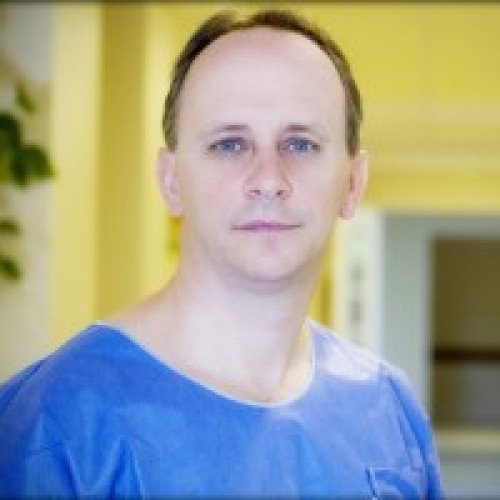
Dr. Tibor Vagács
gastroenterology, surgery
Dr. Tibor Vagács, a surgeon and gastroenterologist, is also known for his empathy and attentiveness among his patients. The excellent and experienced specialist is most happy when he can accompany his patients from the moment of diagnosis to the moment of recovery.
To what extent did growing up in a medical family determine your career choice? Did your father, a well-known surgeon, and your mother, an internist, expect you to follow their path?
— They had no such stipulations at all. As a child, I loved history, so for a long time my greatest desire was to become a historian. I was very interested in the life of a border castle, and my parents and I visited all the castles in Hungary for fun. However, I was not very good at grammar, so although I even achieved a high place in history at the National Secondary School Study Competition, I had absolutely no chance of getting into a classical humanities major. My next choice was geology, as geography was my other favorite subject, but I eventually dropped that too. Of course, the family atmosphere had an impact on me even as a child. I remember that after dinner a car with a siren would regularly come for my father, who was the head of the surgical department at the Tököl prison hospital, to take him to an emergency. I stood on the balcony and didn’t understand why he wasn’t happy about it, since I would have happily gotten into the car with the siren. Many years later, when, after my first Saturday shift – which I operated on – and after Sunday lunch, the phone rang saying that one of my patients was bleeding and I had to go in, I understood how my father must have felt.
As a child, however, he saw the dignity of this work…
— That’s right. And he added that I worked as an ambulance driver for a year after high school. That’s when I really got a sense of what life-saving work meant. It meant a lot both personally and professionally. I worked as a paramedic throughout university, and became a paramedic officer. This sealed my fate for good. I was already preparing to become a traumatologist at that time. I went to the hospital on Uzsoki Street at night to help care for the injured. And I practically assisted in the operating room throughout my fifth and sixth years. I had a brief flare-up in obstetrics, I was so moved by the mystery of the birth of children, but the ethos of the clinic discouraged me from doing so. Surgery remained as a manual profession. Since I did scientific student work for one of the department heads at the Károlyi Sándor Hospital in Újpest at university, I chose that place.
I think in a small hospital, you had to learn everything and solve it in the surgical department.
— Exactly. Although Károlyi was a peripheral hospital in the capital, it still had more than sixty beds. For example, from 2008, our number of surgeries increased so much that we practically lived in the hospital for 4 years, we had to be there day and night. We operated a lot, which meant a lot professionally, but we didn't have a private life.
Despite this, or precisely because of it, what did you like about surgery?
— Mostly the action, the challenge. This is an extremely complex job that often requires quick situational awareness and immediate intervention. Back then, I thought that analyzing findings as an internist wasn't exciting enough. Today, I think it's important to see behind things in this way. The big dilemma for me was choosing the field of the next specialist exam.
Why wasn't being a good and experienced surgeon enough?
— I felt that as a surgeon, you could only work in a very specialized field, say someone who only operates on hernias or, for example, goiters. They can operate brilliantly, but only on this one type of intervention. I felt that this would not motivate me enough after a while. Moreover, I did not feel mentally fit for really big surgical tasks, such as a liver transplant. A surgeon always has to be able to let go of a patient or a complication. That has always been particularly difficult for me.
Did it affect you too much emotionally?
— Yes, but I have learned to live with it. While I knew that the bigger the surgery, the more likely an unexpected complication is to occur. For example, I had a patient who developed a serious complication after surgery. He was admitted to the intensive care unit, and I started seeing him every morning for two months, which was the only way I could calm down. By the way, it has long been a part of my life to visit my patients on weekends, because the responsibility is mine. And the patient is satisfied and heals better if he receives more attention. If a complication occurs by chance, it is easier for them to accept it from a doctor they know and trust. I also realized that even minor surgeries, which are looked down upon by many, make me happy, because the patient's life and quality of life improves as a result. It is very important for me to have the joy of successful healing in my days.
How did you find gastroenterology?
— It found me. For a short time, I also worked in vascular surgery. I felt that if you learn it well, you can do anything. And at Károlyi Hospital, I treated quite a few bleeding patients during my shifts. Moreover, the surgeon-gastroenterologists who stood before me as examples in the hospital were particularly overwhelming and decisive personalities, and this was enough of an impression on me. I started in gastroenterology, passed my specialist examination in it, and soon became the head of the outpatient clinic. In the meantime, I began to transform from a very practical surgeon into an increasingly theoretical internal medicine practitioner.
The surgeon and the serious experience behind you cannot be lost…
— Of course. A surgeon approaches the treatment of an ulcer or the removal of a polyp in a completely different way than an internist, who may have to call in a surgeon if, God forbid, the intestine is damaged. I find that it strengthens patients' trust and cooperation when only one doctor accompanies them throughout, even a serious illness. Most recently, I discovered colon cancer in a young lady during a colonoscopy. We discussed the next steps, the date of the surgery, and subsequent treatments. She was specifically reassured that she belonged to a person, and she felt less lost during her already frightening illness.
Do you also feel reassured that you are with the patient from diagnosis to recovery?
— I definitely feel good about it. I like to be able to put an end to things. In gastroenterology, you also have to think a lot. A patient comes in with a symptom that can have many causes, and I have to first build a series of tests. Then analyze what will follow from it, what the next step should be. This is a more thoughtful medical task than surgery used to be. This field of medicine makes you wiser and calmer. And I am especially glad that Róbert finally has time to discuss everything in detail with the patients.
Do you still have time for yourself?
— Fortunately, now I can pay enough attention to myself and my family. I try to take care of my health, I work out three times a week. And the greatest relaxation is the time spent with my daughter and wife. We walk a lot and play together.

 Log in with GoodID