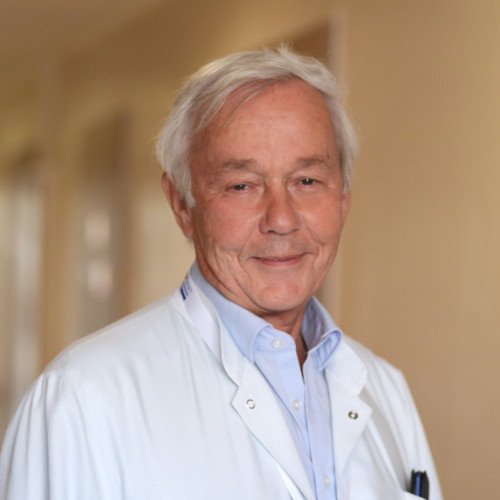
Prof. Dr. Péter Kupcsulik
gastroenterology, surgery
 english-speaking doctor
If you don't involve patients in the healing process, it won't work well, says Professor Kupcsulik.
Prof. Dr. Péter Kupcsulik, surgeon and gastroenterologist, has been devoted to his profession for decades. We can mainly turn to him for gastroenterological consultations, endoscopic examinations and surgeries, as well as for specialist – surgical, oncological, gastroenterological – second opinions. It is remarkable how many milestones we can add to his name in Hungarian medicine.
Prof. Dr. Péter Kupcsulik graduated from the Faculty of General Medicine of the Budapest University of Medicine in 1970, and has been working since then at the 1st Surgical Clinic, which, under his direction (2003–2011), won the “Hospital of the Year” award in 2010. – We performed a very large number of surgeries, the vast majority of which were due to some kind of cancer. We have performed a lot of laparoscopic colon surgeries, but I also have many hours spent in the operating room on diseases of the esophagus, stomach, liver, biliary tract and pancreas,” explained the professor emeritus, who was also asked what excites him most about his work.
The intersection of education and medicine
I am usually interested when something is not self-evident (for example, a surgical situation) and you have to recognize what it is and what the solution is. And in my educational tasks, I feel good when the students are paying attention. Medicine is very similar to education in this sense: if you do not involve the students – or in the case of medicine, the patients – then it does not work well, said Prof. Dr. Péter Kupcsulik, who, in addition to the 120-person Hungarian class, also teaches an English and German class of 40–50 people at the Medical University.
Interestingly, he is responsible for the creation of the “Surgical Master Course” and the “Ars Chirurgiae” lecture series. During his work as head of the department, the Department’s experimental surgical activities were revived, and we can also be very proud of the students: many students from the student association have won awards at university and national events.
Informatics is – unfortunately or not – penetrating medicine to a very large extent. The current 18–20-year-olds have encountered IT tools in sufficient depth, so they will be much better able to apply them in medicine than previous generations. The question is whether their human interest in the patient will remain, or will they only deal with the patient in an IT-based way? There is no answer to this yet, but I would rather have human-like technicians than robot-like technicians – emphasized Prof. Dr. Péter Kupcsulik, the Hungarian pioneer of endoscopic treatment of esophageal varices, the instructor and distributor of the method that is now considered a routine procedure.
Surgery is a continuous decision-making situation
In addition to surgery and endoscopic examination of gastrointestinal diseases, he also does outstanding work in the field of laparoscopic interventions. One example is the domestic application of “single port” (keyhole, umbilical) gallbladder removal. Prof. Dr. Péter Kupcsulik is credited with the application of liver regeneration following hepatic portal vein occlusion to remove liver tumors. He was the organizer and participant of the first liver transplant in Hungary, and the first domestic introducer of several other surgical solutions.
The surgical profession is a little different from other professions. The surgeon has to make decisions constantly, and during surgery he has to choose quickly and well at many different points. I read somewhere that a good surgeon only makes original mistakes, because if he is good enough, he avoids foreseeable mistakes. I have always strived for this, and I strive for it – the surgeon, who is a member and official of several domestic and foreign societies, and was the president of the Hungarian Medical Chamber between 1998 and 2003, shared with us.
A lifelong conversation with Szent-Györgyi and Krebs
Prof. Dr. Péter Kupcsulik gained a lot of experience during his study trips abroad, spending several years in Germany and the United States as a scholarship holder. Both trips were full of memorable moments, which he now spoke about in detail.
I was exceptionally lucky. I was in Bonn on a one and a half year study trip when the meeting of the Nobel Prize winners in medicine was organized in Lindau. At that time, 30-40 Nobel Prize-winning doctors and biochemists gathered there, including Albert Szent-Györgyi and Hans Adolf Krebs. It was a great experience to talk to these gentlemen… Meeting people who were undoubtedly very good at their profession inspired me to try to be as good as I could, too,” recalled the surgeon, who won the International Award of the American Society of Surgeons in 1981.
I was able to visit the outstanding surgical institutions in America that I had only read about in books. Among others, I met Thomas E. Starz, who performed the first liver transplant and is considered the father of modern transplantation. I had to realize that in terms of surgical technique, the clinic I came from was at least as good as the one abroad, only the environment and the level of development of the system were different – so, we were not more clumsy – recalled Prof. Dr. Péter Kupcsulik, who believes that whatever can be done for the patient’s recovery should be done, and one should never give up on these endeavors.
Unforgettable cases
Just like in foreign countries, there is not just one memorable story from the Hungarian field. The doctor shared another one of these with us about the patient he operated on 21 years ago. – Just last week, I met with a patient of mine regarding his other complaints. I haven’t seen him in 21 years. We operated on him in 2000 – his liver was diseased, his portal vein and splenic vein were blocked, he had esophageal varices, which caused massive bleeding, and the lower part of his esophagus died. We operated on him, he recovered. The patient never bled again – said Prof. Dr. Péter Kupcsulik joyfully, whom we last but not least asked about his favorite hobbies. As it turned out, he loves skiing, sailing, cycling, reading, listening to music, and he also happily spends his free time with his dog.

 Log in with GoodID